The Day of Pentecost: What Happened When Heaven Came Down in Fire
Discover the powerful meaning behind The day of Pentecost, the moment the Holy Spirit came with fire, transformed the disciples, and changed the course of history forever.
There are moments in the Bible that completely changed history. The resurrection of Jesus is one of them. The giving of the Ten Commandments is another. But there is one event that often gets less attention than it deserves — The day of Pentecost.
This was the moment when heaven touched earth in a powerful way. Fearful disciples became bold preachers. Ordinary people were filled with extraordinary power. A small gathering in an upper room became the beginning of a worldwide movement that still impacts lives today.
But what really happened on that day?
Why did fire appear?
Why were people speaking different languages?
And why does this event still matter for believers today?
To truly understand Pentecost, we must look deeper than the surface story. When we do, we discover a message about God’s presence, power, and desire to dwell with His people.
What Was The Day of Pentecost?
The word “Pentecost” means “fiftieth.” It was a Jewish feast celebrated fifty days after Passover. Long before the Holy Spirit came in the upper room, Pentecost already existed as an important celebration in Israel.
The feast was connected to thanksgiving and harvest. People gathered in Jerusalem to thank God for provision and blessing. Large crowds traveled from different nations to attend the celebration.
This timing was not random.
Jesus died during Passover as the Lamb of God. Then fifty days later came Pentecost. God was revealing a greater harvest — not crops, but souls.
On that day, thousands of people would come to faith in Christ. What began as a Jewish feast became the birthday of the Church.
Acts 2:1 says:
“When the Day of Pentecost had fully come, they were all with one accord in one place.”
That simple verse introduced one of the greatest spiritual moments in history.
Why Were the Disciples Waiting Before The Day of Pentecost?
After Jesus rose from the dead, the disciples were excited and full of questions. They had seen miracles with their own eyes. They had walked with the risen Christ. Naturally, they may have wanted to begin preaching immediately.
But Jesus gave them a surprising instruction.
He told them to wait.
In Acts 1:4–5, Jesus said:
“Wait for the Promise of the Father… you shall be baptized with the Holy Spirit not many days from now.”
This teaches an important lesson. Passion alone is not enough. Human strength cannot fulfill God’s mission. The disciples needed divine power.
So they gathered together in an upper room and prayed.
About 120 believers waited there in unity. They did not know exactly how the promise would come. They simply trusted the words of Jesus.
Sometimes God prepares people in hidden places before using them publicly. The waiting season is often part of the miracle.
The upper room became a place of surrender, expectation, and prayer. Then suddenly, everything changed.
What Happened on The Day of Pentecost?
Acts chapter 2 describes the moment heaven responded.
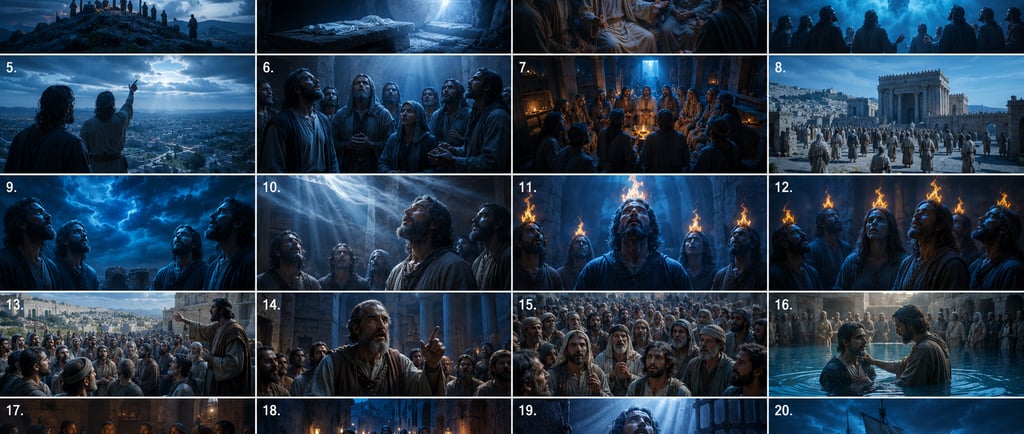
Suddenly, a sound came from heaven like a rushing mighty wind. The noise filled the entire house where the believers were gathered.
Then something even more astonishing happened.
Tongues of fire appeared and rested on each person.
The believers were filled with the Holy Spirit and began speaking in different languages as the Spirit enabled them.
This event was supernatural in every way.
The wind symbolized the breath and power of God. Throughout Scripture, wind often represented the movement of the Spirit.
The fire also carried deep meaning. In the Old Testament, fire represented God’s presence.
God appeared to Moses through a burning bush.
God led Israel with a pillar of fire.
God answered Elijah with fire from heaven.
But Pentecost introduced something new.
In the Old Testament, fire rested on places like mountains and temples. On Pentecost, the fire rested on people.
This showed that believers themselves had become temples of the Holy Spirit.
God was no longer revealing His presence only through buildings. He was now dwelling inside His people.
Why Did Fire Appear on The Day of Pentecost?
Fire in the Bible often represents several things at once.
It represents:
God’s presence
Purity
Power
Holiness
Divine approval
The fire at Pentecost was not there to destroy the disciples. It was there to transform them.
Before Pentecost, the disciples struggled with fear and weakness. Peter denied Jesus three times. The disciples hid behind locked doors after the crucifixion.
But after the Holy Spirit came, everything changed.
Peter boldly preached in front of thousands.
The disciples openly declared the gospel despite persecution.
Men and women who once feared death became fearless witnesses for Christ.
That is what the fire of God does. It changes people from the inside out.
The fire also revealed something beautiful about God’s heart. The flames rested on each believer individually. This meant the Holy Spirit was not only for spiritual leaders or prophets.
The promise was for ordinary people.
Fishermen received it.
Women received it.
Young and old received it.
God’s Spirit was poured out on all who believed.
Why Did People Speak Different Languages During The Day of Pentecost?
Jerusalem was full of visitors from many nations during the feast. People spoke different languages and came from different cultures.
When the disciples began speaking through the power of the Holy Spirit, the crowd was shocked. Each person heard the message in his own language.
Acts 2:7–8 says:
“Are not all these who speak Galileans? And how is it that we hear, each in our own language in which we were born?”
This miracle carried a powerful message.
The gospel was for everyone.
God was showing that salvation would not remain limited to one nation or group. The message of Jesus would spread throughout the world.
Many Bible teachers also connect Pentecost to the Tower of Babel in Genesis 11.
At Babel, human pride caused confusion and division through language. But at Pentecost, the Holy Spirit brought understanding and unity.
Sin divided humanity.
The Spirit brought people together again.
How Did Peter Change After The Day of Pentecost?
One of the most remarkable parts of the story is Peter’s transformation.
Before Pentecost, Peter was afraid.
He denied knowing Jesus when questioned by a servant girl. Fear controlled him.
But after receiving the Holy Spirit, Peter stood before thousands and boldly preached about Christ.
What caused such a dramatic change?
The Holy Spirit gave him courage.
Peter explained that the events happening before the crowd were the fulfillment of prophecy. He quoted the prophet Joel, who had declared that God would pour out His Spirit on all people.
Peter then preached about the death and resurrection of Jesus.
The Bible says the people were “cut to the heart.” They realized they needed forgiveness and salvation.
When they asked what they should do, Peter answered clearly:
“Repent, and let every one of you be baptized in the name of Jesus Christ… and you shall receive the gift of the Holy Spirit.”
That day, about 3,000 people believed.
A frightened fisherman became a powerful preacher because of the Holy Spirit.
Why Is The Day of Pentecost Important for Christians Today?
Pentecost is not just a historical event. Its message still matters today.
Many people think Christianity is only about rules, traditions, or religious routines. But Pentecost reminds us that the Christian life was always meant to be lived through the power of the Holy Spirit.
Without God’s Spirit:
Worship becomes empty.
Ministry becomes exhausting.
Faith becomes dry.
Religion becomes powerless.
The Holy Spirit gives believers strength, wisdom, comfort, and guidance.
He helps people overcome fear.
He brings conviction and transformation.
He produces spiritual fruit such as love, peace, patience, and self-control.
The same Spirit who moved in the book of Acts still works today.
Pentecost reminds believers that God’s presence is not distant. Through the Holy Spirit, God lives within His people.
That truth changes everything.
What Can Believers Learn From The Day of Pentecost?
There are several powerful lessons believers can learn from Pentecost.
God Honors Unity
The believers were gathered together in one accord. They prayed together and waited together.
Division weakens spiritual growth, but unity creates room for God to move powerfully.
Waiting Is Not Wasted
The disciples had to wait before receiving the promise.
Sometimes people want immediate answers and instant breakthroughs. But God often works during seasons of waiting.
Preparation matters.
The Holy Spirit Brings Boldness
Fear disappeared when the Holy Spirit came upon the disciples.
God still gives courage to people who feel weak or uncertain.
God Uses Ordinary People
The disciples were not famous scholars or powerful rulers.
They were ordinary individuals surrendered to God.
Pentecost proves that God can use anyone willing to follow Him.
Spiritual Power Is Meant to Glorify Jesus
The Holy Spirit did not come to make the disciples famous. The focus remained on Jesus Christ.
True spiritual power always points people back to Christ.
Did The Day of Pentecost Fulfill Old Testament Prophecy?
Yes, Pentecost fulfilled several important prophecies.
The prophet Joel foretold a time when God would pour out His Spirit on all flesh.
Ezekiel also prophesied that God would give His people a new heart and put His Spirit within them.
For centuries, people waited for these promises to be fulfilled.
Then Pentecost happened.
This showed that God keeps His promises, even when fulfillment takes time.
It also revealed that God’s plan was always bigger than one nation. The coming of the Holy Spirit opened the door for people from every background to become part of God’s family.
Pentecost was not an unexpected event. It was part of God’s plan from the very beginning.
How Does The Day of Pentecost Still Impact the World?
The impact of Pentecost can still be seen today.
The disciples left the upper room and carried the gospel everywhere they went. Despite persecution, imprisonment, and hardship, the message spread across nations.
The Church continued to grow because it was empowered by the Holy Spirit.
Today, millions of believers around the world still celebrate Pentecost because it reminds them of God’s power and presence.
It reminds people that:
God still changes lives.
God still gives strength.
God still fills hearts with peace and purpose.
God still calls ordinary people into extraordinary missions.
Pentecost also reminds believers that Christianity is not meant to stay inside church buildings.
The disciples carried the message into cities, homes, streets, and nations.
The fire was meant to spread.
What Is the Deeper Meaning Behind The Day of Pentecost?
At its core, Pentecost is about relationship.
From the beginning of Scripture, God desired closeness with humanity.
In Eden, God walked with Adam and Eve.
In the wilderness, His glory filled the tabernacle.
In Jerusalem, His presence rested in the temple.
Then Jesus came as “God with us.”
But Pentecost revealed something even deeper.
God would now dwell within His people through the Holy Spirit.
This changed the relationship between God and believers forever.
Pentecost showed that heaven was not distant.
God came near.
The Spirit became the helper, comforter, teacher, and guide for believers.
That is why Pentecost remains one of the most important moments in the Bible.
It was the day heaven answered with fire.
It was the day fear turned into boldness.
It was the day ordinary people became vessels of God’s power.
And it was the day the Church was born.
What Does The Day of Pentecost Mean for You Personally?
Pentecost is not only a story to admire. It is an invitation.
It invites people to seek God deeply.
It invites believers to live with spiritual passion instead of empty routine.
It reminds weary hearts that God still gives strength and renewal.
Many people today feel spiritually empty, anxious, or overwhelmed. Pentecost points to the answer: the presence of God.
The same Holy Spirit who filled the upper room still transforms lives today.
God still brings peace to troubled hearts.
He still gives courage to fearful people.
He still changes lives through His presence.
Pentecost is ultimately a reminder that God did not leave humanity alone.
He came near.
And He still does.